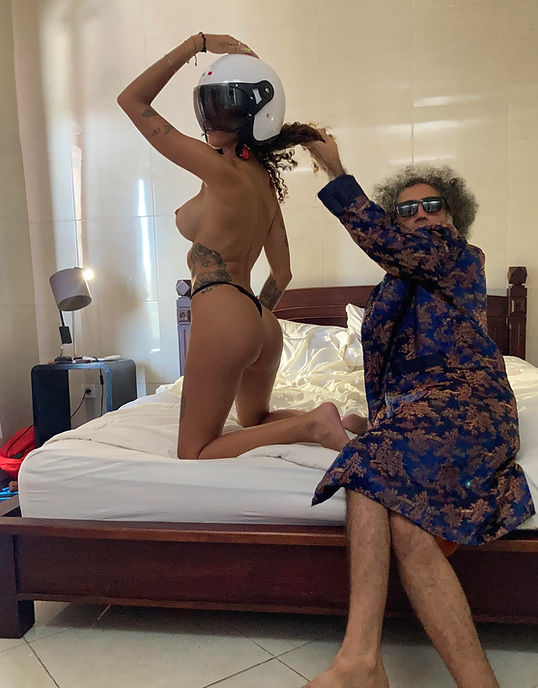
"The Painter with the Biggest Balls"
VAHID SHARIFIAN interviewed by KIMBERLY HUNT January 2026

I asked him directly the question that often hovers unspoken around artists who provoke discomfort.
Do you care what people think of you?
It’s a question that usually invites hedging. A moment to calibrate. A chance to soften the answer just enough to sound reasonable. When I asked Vahid Sharifian, none of that happened.
“No,” he said. “I don’t care what they think.”
There was no heat in it. No defensiveness. Just certainty. The kind that comes from someone who has already spent years testing the alternative and found it unnecessary.
“No, I don’t care what they think. If they think what I make is vulgar, I don’t stir away from what I’m painting,” he continued. “I’ve been obsessed with the history of art, and I know exactly what I’m doing. It’s edgy, sure, but the aesthetic of women’s beauty is my absolute priority. I don’t give a damn if they call my work perverted. Being a little perverted has always been part of how desire shows up in art. You just have to know the line between creepy and beautifully perverse.”
That line matters to him. He doesn’t talk about it theatrically. He talks about it like something you’re responsible for knowing.
Sharifian’s work is widely loved, circulated online, and collected by individuals, yet still hesitated over by institutions that claim to champion risk but rarely practice it. His paintings are bold, erotic, and unembarrassed. They depict women not as symbols or metaphors but as presences. Flesh, light, attitude. The kind of work people respond to immediately. You feel it in your stomach before your brain catches up.


Then he said something that stayed with me long after our call.
“Ego is just something that stops you from being successful.”
He makes a clear distinction between ego and confidence. Confidence is necessary. Confidence is clarity. Ego is noise. Ego is the thing that distracts artists into chasing approval instead of making work.
In true Vahid fashion, he’s equally frank about success.
“I’ve always been against the current,” he said. “I never fake myself. I’m lucky. Even without having contracts with galleries, I’m still selling better than many artists in my generation who do.”
Vahid looks exactly like you would hope. A funk afro Hugh Hefner type, equal parts bohemian and self possessed, with the confidence of someone who has stopped asking for permission. He is a nomad by instinct, living and working between cities, chasing light, following women, painting wherever desire and circumstance intersect.
We talked about his fascination with the female form, a subject that inevitably invites scrutiny. He traces it back further than most artists are willing to go. Back before he was even born. His mother wanted a girl when she was pregnant with him. He likes to think that desire mattered. That it shaped his sensitivity. His perspective. His devotion to femininity.
When he paints surreal work, he allows imagination to roam. But when he paints women, he wants something else entirely.
“When I paint women,” he said, “I want it pure. Real.”
It’s a line that could sound naive in the wrong mouth. With him, it doesn’t. Purity is not modesty. It’s sincerity. It’s seeing without apology.
He’s aware of the risk.
“You are radioactive if you paint women and you’re a man,” he said.
Only after spending time with the work does it make sense that Sharifian lives the way he does. He’s a nomad by instinct, moving between cities, painting wherever desire and circumstance intersect.

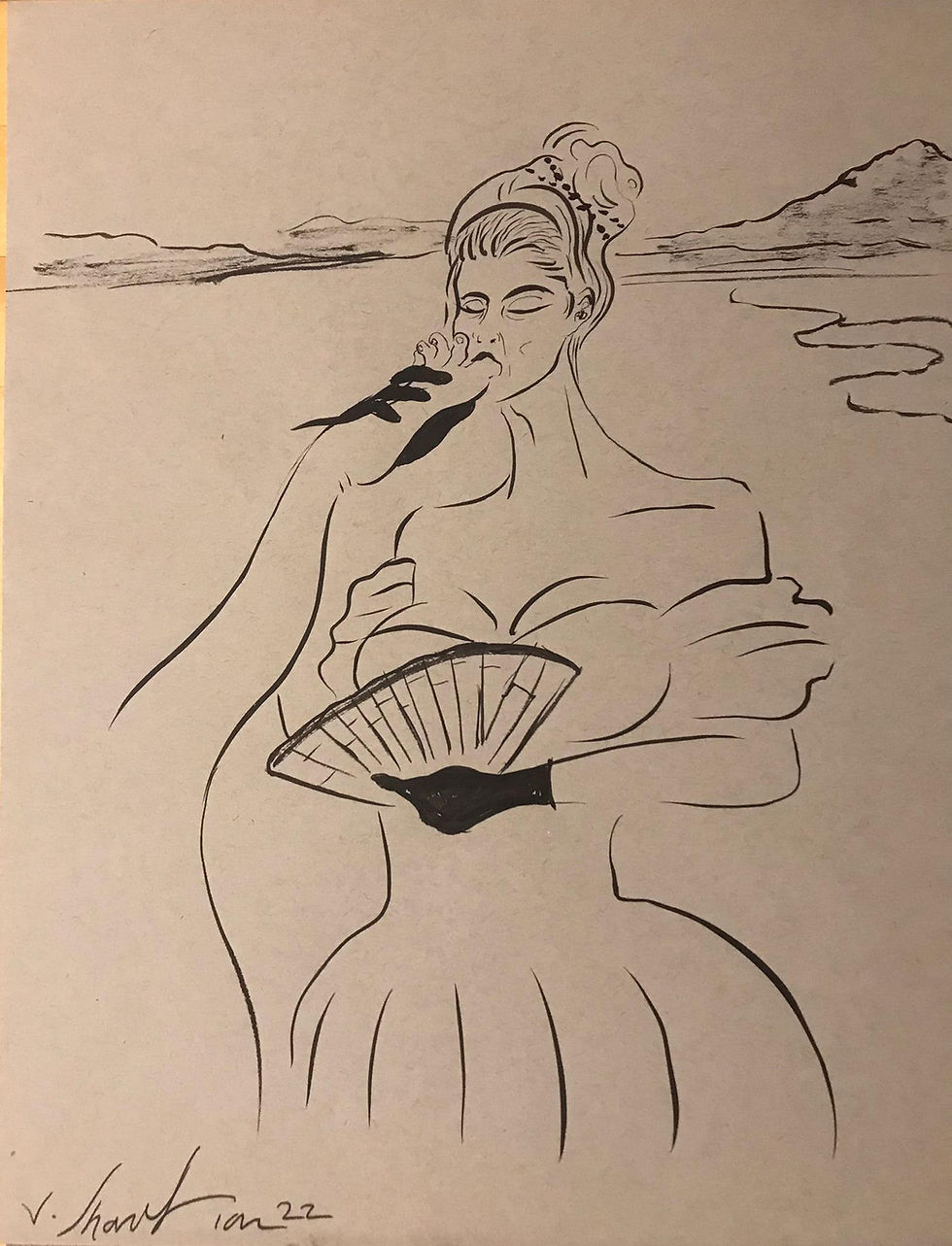

Paris. Mexico City. New York. Los Angeles.
Each place leaves a residue. The work absorbs it. When he spoke about Los Angeles, something shifted.
“LA has an amazing light,” he said. “It’s melancholic. The light there comes from a different sun.”
There was a sincerity in the way he described it that caught me off guard. It wasn’t romanticized. It was reverent.
“You can’t imagine how beautiful that light is,” he added. “When you paint it, God.”
It was one of those moments where you stop thinking about the next question and let the sentence sit.
His muses come to him in different ways. Early on, he painted women he found online, always asking permission, careful and deliberate. Now he photographs them himself. The process is slower. More intimate. Built on trust. He’s attentive to boundaries even as the work itself presses against comfort.
Throughout our conversation, one belief kept resurfacing.
While we’re living in a hyperreal, neon, post-Rococo moment, the official art scene feels strangely anemic.
“The official art scene is so pale,” he said. “What happened to the fire? The rebellion that makes the heartbeat?”


For Sharifian, that loss of fire mirrors something broader. A growing discomfort with closeness. With bodies. With proximity. Standing arm-in-arm now feels loaded. Touch is negotiated. Physical presence is something to manage rather than inhabit.
Anything that genuinely brings people together complicates control. Shared space. Shared attention. Shared instinct. Distance, on the other hand, is easy to regulate. Fear creates space. Caution creates isolation. In that environment, rebellion is easier to package and easier to neutralize.
“It’s all controlled now,” he said. “And control does not like beauty.”
That sentence stayed with me long after meeting.
For Sharifian, art loses its power the moment it’s assigned a purpose. When art is made to serve ideology, morality, or politics first, it stops being art and becomes instruction. Messaging. Propaganda. The impulse shifts from inspiration to agenda. What once felt like rebellion now feels rehearsed. Pre-approved. Safe.
Maybe that’s what unsettles people about his work.
It refuses control. It refuses restraint. It insists on beauty even when beauty feels dangerous and it takes big balls.